
Glyphosate & Our Food
UPDATE: Please see the section “Regulatory Classification & Ongoing Debate” below for the current stance of the U.S. government on glyphosate use and safety evaluations.
Glyphosate exposure in America continues to raise discussion among environmental health researchers and respected voices in the wellness community. Herbicide residues in the American food supply are increasingly examined by integrative physicians, soil scientists, and regenerative agriculture advocates. Many question long-term cumulative exposure patterns.
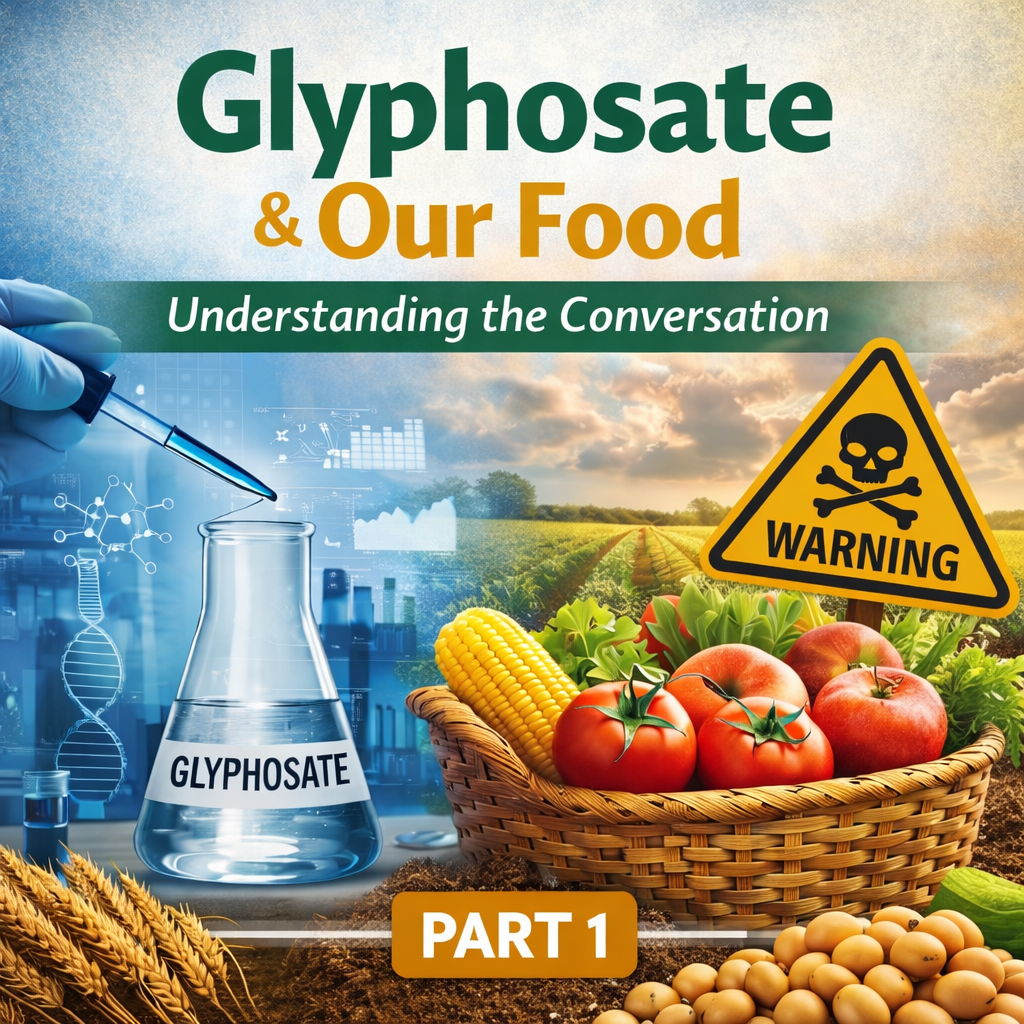
Glyphosate is a widely used agricultural herbicide designed to control weeds and unwanted plants in farming systems.
The herbicide glyphosate, the active ingredient in Roundup, was originally developed by Monsanto and is now manufactured by Bayer. It remains one of the most widely used herbicides in U.S. agriculture. Farmers apply it to genetically engineered crops such as corn and soy. It’s used as a pre-harvest drying agent on wheat, oats, legumes, and other grains before harvest.
Because of its widespread agricultural use, detectable residues have been reported in various conventional food products. While regulatory agencies maintain established exposure limits based on risk assessments. However, the presence of residues continues to prompt discussion among scientists and consumers about long-term dietary exposure.
Sources:
U.S. Environmental Protection Agency (EPA): https://www.epa.gov/ingredients-used-pesticide-products/glyphosate
National Pesticide Information Center (NPIC): http://npic.orst.edu/factsheets/glyphogen.html
Herbicide Residue in the American Food Supply
Independent consumer advocacy organizations and government monitoring programs have conducted testing. Their research helps show how often glyphosate residues appear in commonly consumed foods.
The Environmental Working Group (EWG) has published several reports examining glyphosate residues in oat-based cereals, granola bars, and other grain-derived products. Their testing has reported detectable glyphosate residues in a number of popular oat-based foods. These reports typically focus on how often residues are detected and how repeated dietary exposure from multiple foods could contribute to overall cumulative intake over time.
How Residues Can Appear on Crops
Grains such as oats, wheat, and barley are sometimes treated with glyphosate before harvest as a drying agent, a practice known as pre-harvest desiccation. This agricultural technique helps crops dry more evenly in the field, making harvesting more efficient. Because the herbicide is applied shortly before harvest in these cases, trace residues may sometimes remain on harvested grains.
In addition to advocacy testing, the U.S. Department of Agriculture’s Pesticide Data Program (PDP) conducts annual nationwide sampling of fruits, vegetables, grains, and other foods sold in the United States. These reports measure pesticide residues and compare them against federal tolerance levels established by the U.S. Environmental Protection Agency (EPA). The PDP program provides regulators with data used to monitor compliance with existing pesticide safety standards.
Even some organic grain samples have occasionally shown trace detections of glyphosate. Under USDA organic standards, farmers are prohibited from applying synthetic herbicides such as glyphosate directly to certified organic crops. However, researchers note several possible pathways for low-level contamination. These may include environmental drift from nearby conventional fields and contamination during shared storage or transportation.
Because of these findings, discussions about herbicide residues and glyphosate use in agriculture often extend beyond individual foods. They now include broader questions about farming practices, supply chains, and pesticide management.
For many consumers, these reports have increased interest in understanding how food is grown, how crops are processed, and what certifications mean. As a result, conversations about glyphosate frequently intersect with broader discussions about organic farming, regenerative agriculture, and soil stewardship.
Sources:
Environmental Working Group (EWG): https://www.ewg.org
USDA Pesticide Data Program: https://www.ams.usda.gov/datasets/pdp
National Pesticide Information Center (NPIC): http://npic.orst.edu
Regulatory Classification & Ongoing Debate
In 2015, the International Agency for Research on Cancer (IARC), part of the World Health Organization, classified glyphosate as “probably carcinogenic to humans” (Group 2A). IARC’s evaluation focuses on hazard identification — whether a substance has the potential to cause harm under certain conditions.
By contrast, the U.S. Environmental Protection Agency (EPA) concluded that glyphosate is not likely to be carcinogenic to humans when used according to labeled instructions. It is currently the position of the U.S. government, through the EPA, that glyphosate is permitted for use within established regulatory guidelines. European regulatory agencies have conducted separate risk assessments and renewed approval with defined time limits and conditions.
These differing evaluations reflect variations in scientific methodology and regulatory philosophy.
Sources:
IARC Monographs Volume 112: https://monographs.iarc.who.int/list-of-classifications
U.S. EPA Registration Review: https://www.epa.gov/ingredients-used-pesticide-products/glyphosate
European Food Safety Authority (EFSA): https://efsa.onlinelibrary.wiley.com/action/doSearch?AllField=glyphosate
Voices in the Wellness Community
Several respected voices within integrative and environmental health continue to raise questions about glyphosate’s broader role in modern agriculture and food systems. These clinicians and researchers often discuss glyphosate within larger conversations about soil health, food quality, and sustainable farming practices.
Dr. Stephanie Seneff, a research scientist formerly affiliated with MIT, has studied how glyphosate affects the shikimate pathway, a natural process plants and certain microbes use to produce important compounds needed for growth. Scientists examine this process in laboratory studies to better understand how herbicides interact with plant biology and microorganisms.
Dr. Mark Hyman, a functional medicine physician and author, frequently discusses soil health, industrial agriculture, and regenerative farming solutions in broader conversations about nutrition and metabolic health. In his writing and educational programs, he often highlights how farming practices influence food quality and encourages support for regenerative agricultural systems.
Dr. Joseph Mercola, an osteopathic physician and health educator, has written about glyphosate in relation to food transparency and agricultural practices. Through his brand Solspring, he promotes biodynamic and regenerative farming methods that exclude synthetic herbicides and emphasize soil vitality and ecological balance.
While their perspectives vary, these voices often emphasize precaution and greater transparency in food production. They also support agricultural models that prioritize soil health and regenerative practices.
Sources:
Seneff, S. et al., Entropy (2013): https://www.mdpi.com/1099-4300/15/4/1416
Dr. Mark Hyman: https://drhyman.com</a>
Dr. Joseph Mercola: https://search.mercola.com/results.aspx?q=glyphosate
International Policy Differences
As glyphosate use in agriculture continues to be studied and debated, countries around the world have taken different approaches to regulating its use.
Some governments have announced plans to reduce or phase out glyphosate use. Others continue to allow it under regulatory oversight while investing in alternative agricultural systems such as organic farming. These policy differences reflect how each country balances food production, environmental protection, and economic priorities.
Global regulatory approaches to glyphosate differ significantly.
- Mexico has announced plans to phase out glyphosate use within its national agricultural strategy.
• Germany has proposed reductions aligned with biodiversity initiatives.
• The European Union has renewed approval with time limitations and review requirements.
• Sri Lanka previously implemented a ban and later revised policy.
Russia continues to permit glyphosate use, but it is also pursuing a major expansion of organic agriculture. Russia plans to significantly increase organic food production by 2030. The market could grow from about 9 billion rubles to more than 114 billion rubles. A ruble is Russia’s national currency, similar to how the United States uses dollars.
The country also plans to expand certified organic farmland from about 656,000 hectares to 4.2 million hectares. Since one hectare equals roughly 2.5 acres, that means increasing organic farmland from about 1.6 million acres to more than 10 million acres.
The strategy includes encouraging domestic organic consumption, expanding exports, and supporting farmers with environmentally friendly technologies. Analysts note that achieving these ambitious goals will require sustained policy support and investment.
These variations reflect differing national agricultural priorities and regulatory models rather than a single global consensus.
Sources:
European Commission: https://food.ec.europa.eu
German Federal Ministry for the Environment: https://www.bundesumweltministerium.de/en
Russian Federal Service: https://fsvps.gov.ru
Interfax – Organic Development Reports
Tridge – Russian Organic Market Overview
A Growing Global Conversation
As research continues and regulatory approaches vary around the world, glyphosate has become part of a much larger conversation about modern agriculture. Farmers, scientists, policymakers, and consumers are increasingly examining how food production systems affect soil health, ecosystems, and long-term sustainability.
While debate about glyphosate continues in scientific and regulatory circles. Many people are also exploring constructive agricultural alternatives. These approaches focus on rebuilding soil biology and strengthening natural ecosystems.
This shift is shaping new conversations about how food is grown and how future farming systems may evolve. As interest in these ideas continues to grow, many people are looking toward farming practices that work more closely with nature.
Coming Soon: Part 2
While global discussions about glyphosate continue, many farmers, researchers, and consumers are exploring constructive agricultural alternatives.
In Part 2 of this series, we will explore the growing movement toward organic, biodynamic, and regenerative farming practices, including research from the Rodale Institute and emerging soil-centered agricultural systems.
We will also examine how these farming approaches work, why soil biology matters, and practical steps consumers can take to support healthier food systems.
Part 2 will explore:
- The Rodale Institute’s long-term soil research
• The living ecosystem beneath our feet — microbes, fungi, and earthworms
• Organic, biodynamic, and regenerative farming explained
• Demeter Biodynamic certification
• Consumer steps toward reducing exposure
• A hopeful path forward for soil stewardship
Part 2 of this series will be published soon.
Educational Disclaimer:
This article is intended for educational purposes and reflects our understanding of the information available at the time of publication. It is not intended to provide medical advice or make health claims.