
Decoding Wellness Labels
Wellness label name changes have become more noticeable in recent years.
Changes in ingredient names frequently reflect updates in science, regulations, or labeling guidelines rather than changes to the product itself.
As a result, many shoppers pause when reading labels. Words may seem unfamiliar. Names may look longer. However, unfamiliar language does not always signal a new or different product.
This article shares what we understand about these changes today. We explain the names you may see and why they may look different from how they once did. Our goal is clarity. We want labels to feel easier to read, not overwhelming.
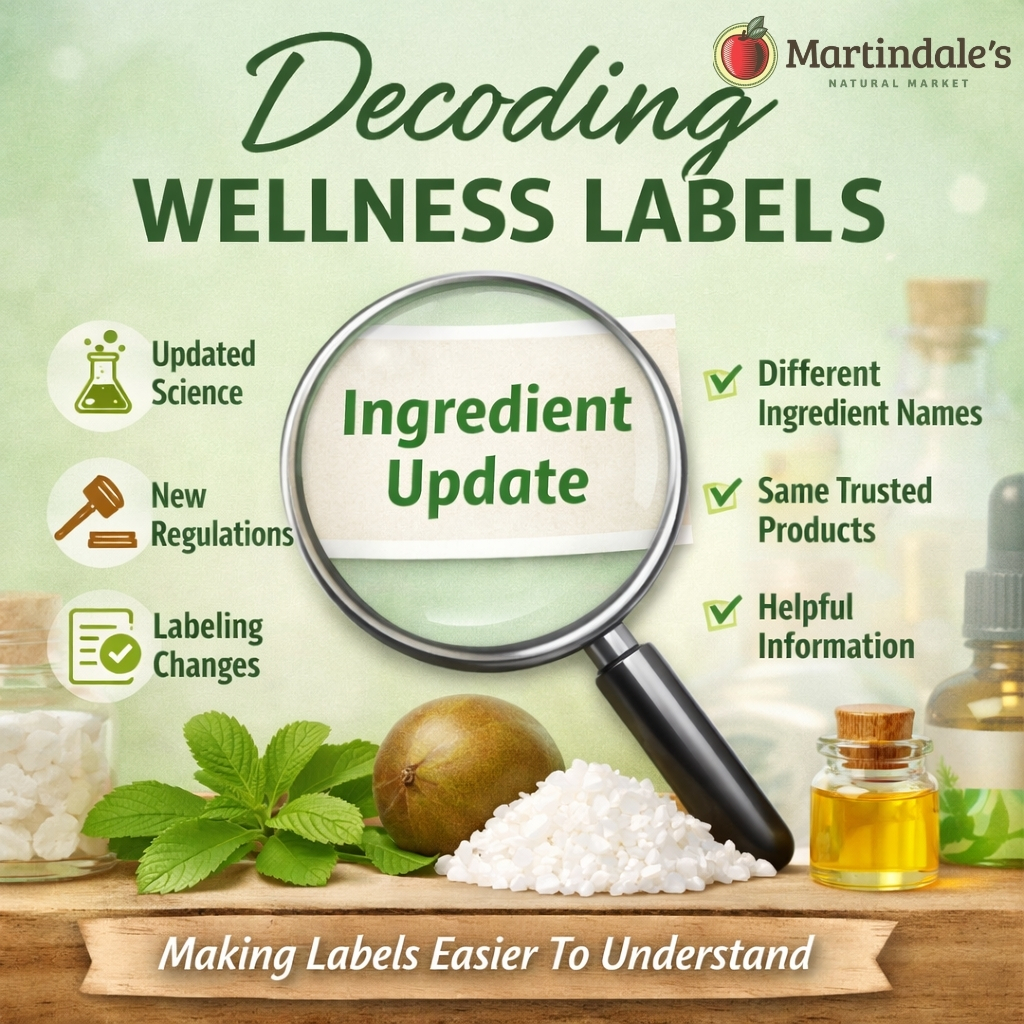
Ingredient Name Changes Explained
Over time, science improves. Regulations also evolve. Because of this, labels change to remain accurate and consistent. In many cases, new wording adds detail rather than confusion.
Below, we walk through common wellness categories. Each section explains the language you may see and why it changed.
Learn more:
U.S. Food & Drug Administration – Food Labeling & Nutrition
https://www.fda.gov/food/nutrition-food-labeling-and-critical-foods
Stevia & Natural Sweeteners
Names you may see
- Stevia
- Stevia leaf extract
- Steviol glycosides
- Reb A or Reb M
- E 960 or INS 960
- Fermentation-derived stevia
Why the name changed
Stevia comes from a plant. However, only certain compounds in the plant contribute to sweetness. As research advanced, scientists learned how to identify and describe these compounds more precisely.
Some names refer to the plant itself. Others identify the sweet compounds. Still others describe how those compounds are produced or refined. As labeling guidelines became more specific, manufacturers were required to use more precise terminology.
Learn more:
World Health Organization / FAO – JECFA Steviol Glycosides Database
https://apps.who.int/food-additives-contaminants-jecfa-database/Home/Chemical/267
Natural Flavors
Names you may see
- Natural flavors
- Natural flavoring
- Flavor blend
Why the name changed
Flavor blends often contain many ingredients used in very small amounts. Listing each one would make the labels long and difficult to read. Labeling rules allow these ingredients to be grouped under the term “natural flavors” when they come from natural sources.
This approach keeps labels readable and protects proprietary recipes. While the term may feel vague, it is a long-standing labeling category rather than a new one.
Learn more:
21 CFR §101.22 – Natural Flavor Definition (via Cornell Law)
https://www.law.cornell.edu/cfr/text/21/101.22
Monk Fruit & Other Plant Sweeteners
Names you may see
- Monk fruit
- Monk fruit extract
- Luo Han Guo
- Mogrosides
Why the name changed
Monk fruit has been used for generations in other parts of the world. Different names reflect different languages, scientific descriptions, and parts of the fruit.
Some labels use traditional names. Others use English names. Some list the substances contributing to sweetness. These names describe the same source from different perspectives.
Learn more: How Sweet It Is: All About Sweeteners — U.S. Food & Drug Administration
https://www.fda.gov/consumers/consumer-updates/how-sweet-it-all-about-sweeteners
Sugar Alcohols (Xylitol, Erythritol)
Names you may see
- Xylitol (sometimes marketed as “birch sugar”)
- Erythritol
- Sugar alcohols
Why the name changed
“Sugar alcohol” is a scientific classification based on chemical structure. It does not describe taste or source. Marketing language may highlight where an ingredient comes from, whereas scientific language focuses on its structure.
This difference in terminology can make ingredients seem unfamiliar. In most cases, the ingredient itself has not changed.
Learn more: How Sweet It Is: All About Sweeteners — U.S. Food & Drug Administration
https://www.fda.gov/consumers/consumer-updates/how-sweet-it-all-about-sweeteners
Vitamins & Nutrients
Names you may see
- Vitamin C / ascorbic acid
- Vitamin B9 / folate / folic acid
- Vitamin B3 / niacin/niacinamide
Why the name changed
Vitamins often have both common and scientific names. Over time, labels have increasingly included both to align consumer language with medical and research standards.
This practice supports consistency among healthcare, manufacturing, and regulation. It does not indicate a different nutrient.
Learn more:
National Institutes of Health – Office of Dietary Supplements
https://ods.od.nih.gov
Probiotics & Fermented Foods
Names you may see
- Long scientific names
- Letter-and-number strain identifiers
Why the name changed
Probiotics are living organisms. Precise naming matters. Scientific names and strain identifiers help professionals distinguish between similar bacteria and sustain consistency across products.
As research expanded, labels became more specific to reflect that accuracy.
Learn more:
International Scientific Association for Probiotics and Prebiotics
https://isappscience.org
Vaccines & Medical Products
(Language and naming only)
Names you may see
- Vaccine
- Immunization
- Biologic or biological product
- Brand name and official medical name
Why the name changed
Vaccines are regulated within a wider category called biological products. This terminology appears in regulatory documents, medical records, and administrative systems.
Every day conversation often uses the word “vaccine.” Official systems may use broader or more technical language. These terms usually refer to the same product, depending on context.
Learn more:
U.S. Food & Drug Administration – Center for Biologics Evaluation and Research (CBER)
https://www.fda.gov/about-fda/fda-organization/center-biologics-evaluation-and-research-cber
From Our Hearts to Yours
We understand how unsettling label changes can feel. When familiar products are described in unfamiliar ways, questions naturally arise. At Martindale’s we are doing our best to share what we understand based on current labeling guidelines and reputable sources, knowing that language and standards continue to evolve.
We believe that confusion is not of God, and we hope that information brings clarity rather than concern. We encourage everyone to read labels carefully, ask questions, and take time to do their own research using trusted sources. Wellness is personal, and each person’s choices deserve respect. If a label ever seems confusing, we are always here to help explain what the words mean — with honesty, patience, and care.
These statements have not been evaluated by the FDA. They are not intended to treat, diagnose, cure or prevent any disease.