
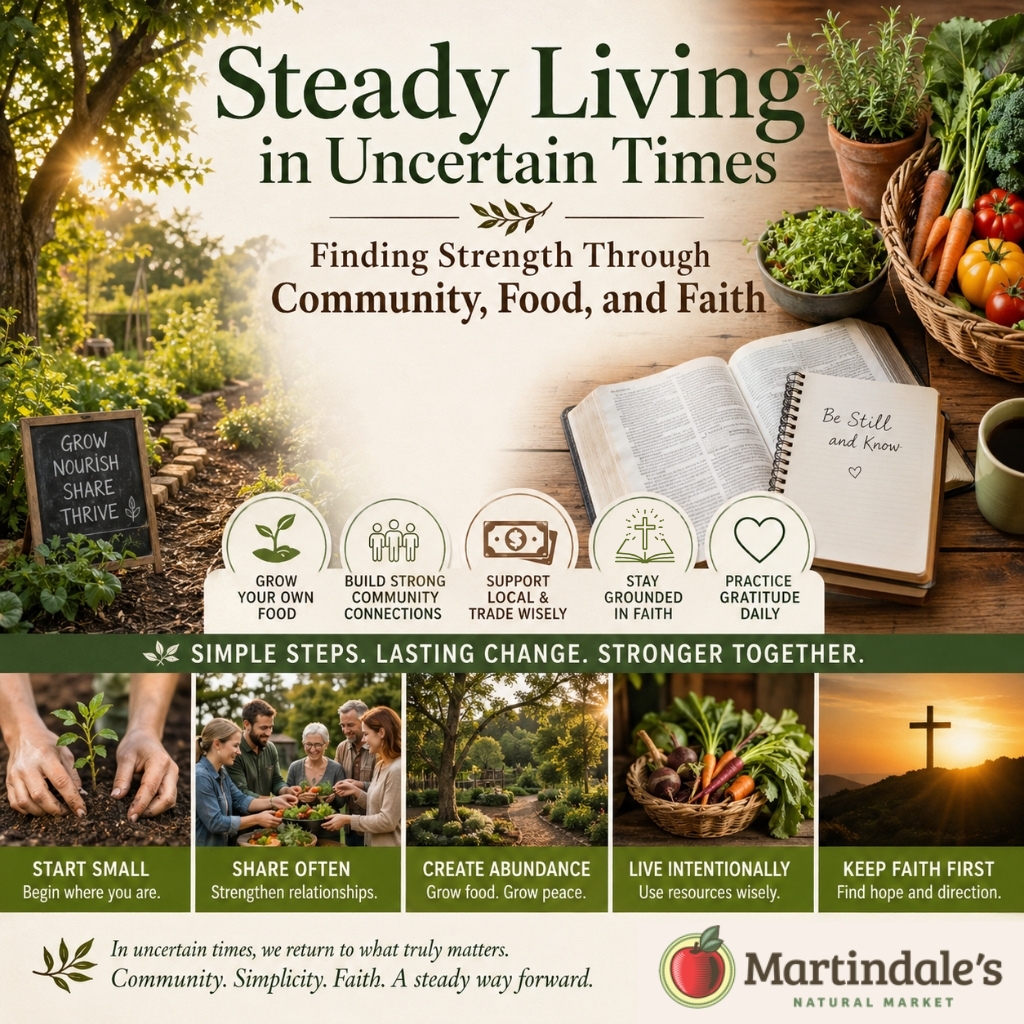
Steady Living in Uncertain Times
Finding Strength Through Community, Food, and Faith
Self-sufficiency lifestyle choices are becoming more common as people look for stability in uncertain times. A community resilience approach offers a steady way forward, especially as so much around us continues to shift.
There’s no denying it—things feel different lately. The pace of change is fast. Technology is everywhere. Information never really stops. For many people, it creates a sense of unease, like we’re moving through something unfamiliar without a clear map.
It’s normal to feel that way.
And yet, even in the middle of all that change, some things don’t really change at all.
Growing food. Knowing your neighbors. Taking time to slow down. These aren’t new ideas—but they’re steady ones. They’ve carried people through uncertain times long before us.
At Martindale’s, we see more people returning to those basics. Not in a dramatic way—just small shifts. And often, that’s where something meaningful begins.
A good place to start is right at home.
Building a Self-Sufficiency Lifestyle Locally
Start Small. Grow Steady.
You don’t need a large garden or a perfect setup to begin. In fact, starting small is often what works best.
A few plants can go a long way. Many people begin with familiar options—tomatoes, leafy greens, or a handful of herbs. They’re simple to manage, and they give you a quick sense of progress.
There’s also something satisfying about picking food you’ve grown yourself, even if it’s just a small amount.
Over time, people naturally expand. Maybe a few more plants. Possibly something perennial. It builds gradually.
And then, almost without trying, it starts to go beyond your own space.
Create a Small Backyard Food Forest
For some, that next step looks like creating a more layered growing space—sometimes called a small “food forest.”
It doesn’t have to be complicated. The idea is simple: different plants growing together in a way that feels natural.
You might start with a fruit tree as the centerpiece. Around it, berry bushes can fill in, while herbs or ground cover grow closer to the soil. Over time, it begins to feel less like a garden and more like a small ecosystem.
People often notice other changes too. Pollinators show up more frequently. The soil improves. The air improves. The space itself feels calmer.
And honestly, that part matters just as much.
A small garden can become a place to step away for a few minutes. To think—or not think at all.
Eventually, these spaces don’t stay isolated. They become something you share.
Share the Harvest Locally
Once you’re growing food, it’s natural to talk about it. And then, almost naturally, to share it.
Sometimes it happens informally. One neighbor grows zucchini. Someone else has herbs. Another family keeps chickens. Before long, small exchanges begin to take shape.
It doesn’t take much effort for that shift to happen.
And that’s where something changes. It’s no longer just about food—it becomes about connection.
Start with a Few Trusted People
You don’t need a large network to build something meaningful. Just a few people are enough.
People you trust. People who are open to sharing ideas, helping out, or trading when needed.
It grows slowly, and that’s okay. In fact, that’s often what makes it sustainable.
Over time, something else becomes clear—there’s a lot to learn from those who’ve already lived through similar experiences.
Tap Into the Wisdom of Our Elders
Some of the most useful knowledge isn’t new. It’s been around for a long time.
Older generations often carry that knowledge with them—not from theory, but from experience.
They’ve learned how to preserve food without waste, how to cook simply and well, and how to adjust to the rhythms of the seasons. Many have also experienced uncertainty before and found ways through it.
Spending time with them—really listening—can bring a lot of that back into focus.
And it’s not just practical. There’s something grounding about those conversations. A different perspective. A longer view.
From there, it becomes easier to start applying those ideas in everyday life.
Passing Knowledge Forward
While younger generations can learn a great deal from elders, the exchange doesn’t have to be one-sided. In many cases, older generations are looking for meaningful ways to stay connected and involved.
Sharing knowledge can be a powerful place to start.
Simple actions can make a lasting impact:
- Teaching a favorite recipe or cooking technique
- Showing how to preserve or store food
- Sharing gardening tips from years of experience
- Talking through lessons learned during past challenges
These moments don’t need to be formal. In fact, they often happen naturally—around the kitchen, in the garden, or during everyday conversations.
In addition, passing knowledge forward helps preserve skills that might otherwise be lost. It also creates a sense of purpose and connection across generations.
Over time, these shared experiences can shape not just practical habits, but values as well.
Reclaiming Food Awareness at Home
Learn Simple Food Skills
Growing food is one part of it. Knowing what to do with it is another.
That might mean cooking more from scratch, learning how to store food properly, or preserving what’s in season so it lasts longer.
It doesn’t need to be perfect. Just a little more intentional.
And over time, those small habits start to influence other choices too.
Supporting Local and Practical Economies
Keep It Local When Possible
Many people find themselves paying closer attention to where they shop.
Local farms. Small businesses. Places where you can trace where something came from.
It creates a different kind of connection—not just to the food, but to the people behind it.
Consider Flexible Ways to Transact
Alongside that, some people begin thinking about how they exchange value.
In certain situations, cash feels simple and direct—especially in local settings. Others explore things like bartering, trading services, or supporting independent vendors whenever they can.
There’s no one right approach here. It really comes down to what feels practical and aligned with your needs.
Think Long-Term with Resources
At some point, that thinking extends a bit further.
Planning ahead. Being a little more mindful about resources.
Not out of fear—just awareness.
Using Technology with Intention
Stay Grounded in Real Life
Technology isn’t going anywhere. But balance matters.
Hands-on skills—gardening, cooking, fixing things—offer something different. They’re tangible. You can see the results. And over time, they build confidence.
Step Away from Constant Noise
Sometimes, the most helpful thing is simply stepping back.
Less scrolling. Less noise. Fewer constant inputs.
More time outside. More real conversations.
That shift creates space to think clearly again.
And often, that’s when people start to look inward.
Spiritual Grounding for Everyday Strength
For many, this is where things become more personal.
Make Time for Prayer
Prayer doesn’t need to be structured or long.
Just a few quiet moments can make a difference—a pause in the day to slow down, reflect, and reset.
Turn to Scripture for Wisdom
Many people also turn to the Bible for guidance.
The Beatitudes (Matthew 5:3–12) are one example:
- “Blessed are the poor in spirit, for theirs is the kingdom of heaven.
- Blessed are those who mourn, for they shall be comforted.
- Blessed are the meek, for they shall inherit the earth.
- Blessed are those who hunger and thirst for righteousness, for they shall be satisfied.
- Blessed are the merciful, for they shall receive mercy.
- Blessed are the pure in heart, for they shall see God.
- Blessed are the peacemakers, for they shall be called sons of God.
- Blessed are those who are persecuted for righteousness’ sake, for theirs is the kingdom of heaven.”
There’s something steady about those words. They’ve lasted—and continue to resonate.
Create Quiet Moments Each Day
Even a few minutes of quiet can help.
No distractions. Just space.
Practice Gratitude with Intention
Gratitude doesn’t need to be complicated.
Sometimes it’s as simple as noticing what’s already there—a good meal, a meaningful conversation, or a quiet moment in the day.
And over time, those moments begin to add up.
Simple Steps to Get Started
If you’re not sure where to begin, keep it simple.
This Week
Plant something small. Reach out to someone nearby.
This Month
Learn one new skill. Visit a local market.
This Year
Build a few strong connections. Share what you learn.
A Community-Centered Approach
At Martindale’s, we believe there is good news—even in uncertain times.
Many of the things that support well-being haven’t changed.
And maybe that’s the point.
When we return to simple habits—food, connection, reflection—we often find something steady again.
Educational Note
This content is for educational purposes only. Individual approaches may vary.